When Horaizon hired their first employees in the summer of 2025, the three co-founders ran into a problem. For a year, it had just been the three of them: Luke Gregory (CEO), Lukas Benic (CTO), and William Wandt (COO), three close friends from university, building an AI consultancy across Copenhagen and London.
Every meeting kicked off with the same question: Where should we talk?
They had conversations spread across Facebook Messenger, Google Meet, Discord, and a handful of group chats depending on who had their laptop, who was traveling, and what kind of conversation it was.
It was a workable setup for three people who knew each other well and could adapt on the fly. With new hires in the mix, it didn’t make sense. They needed a system.
On top of that, the harder problem was their team culture. Those new employees were developers, each running their own projects. They could go a full week without speaking to each other except for a CTO check-in here and there.
They felt less like a team and more like a group of contractors operating under the same roof. That's when one of Horaizon's new hires, a student worker who'd used a virtual office on Gather at a previous company, suggested they try it.
Horaizon’s CEO knew Gather was worth it in less than two weeks
Luke will be the first to tell you that Horaizon runs lean. "Only spend money if it makes money" is more or less their operating principle, especially in those early days. So when they started their free trial of Gather, the expectation was pretty clear: try it out, see if it sticks, probably move on.
It took less than two weeks to change their minds.
"It changed everything for the way we work within a team," Luke said.
The small things were what did it first. Logging on in the morning and seeing who was already at their desk. Knowing at a glance whether a co-founder was heads-down or available. Popping over without the overhead of "hey, do you have five minutes? Let me send you a link." Questions that used to require scheduling a call — waiting for the link, reconnecting, and then trying to remember what you even needed to ask — suddenly took three minutes.
And there was something else: you stop feeling like you're bothering people. In Gather, if someone's showing as active, that's a signal. Luke described it simply: "I can see that they want to be found." No preamble, no calendar invite. Just walk over.
"I can't imagine working remotely in a team without it now."
Luke Gregory, CEO, Horaizon
Remote collaboration finally felt natural
Luke expected Gather to help with onboarding new team members, people he'd never met in person, trying to find their footing in a fully remote environment.
What surprised him was how much it changed things with his two co-founders, people he'd known and worked with for seven years. He thought they worked well together, and it turns out, with a virtual office to operate from, they work even better.
"Whenever one of my co-founders is active and sitting in their office, I can just run over,” Luke shared. “Maybe just for five minutes. Maybe it turns into an hour." It doesn’t feel like they’re interrupting or micro-managing each other. It’s just genuine, natural conversation.
That dynamic extended into the weekends, too. Before Gather, a Saturday work session meant wondering if you should bother your co-founders, even when you were all quietly online. "Now, even if it’s Sunday at 8 pm, I can see if my co-founders are online,” Luke shared. “If I want to talk to them about the Monday meeting, I can, without feeling like I’m bothering anybody.”
The ripple effect was measurable.
By using Gather, messages on Slack and Google Chat dropped by about 80%.
Inside Horaizon’s virtual office
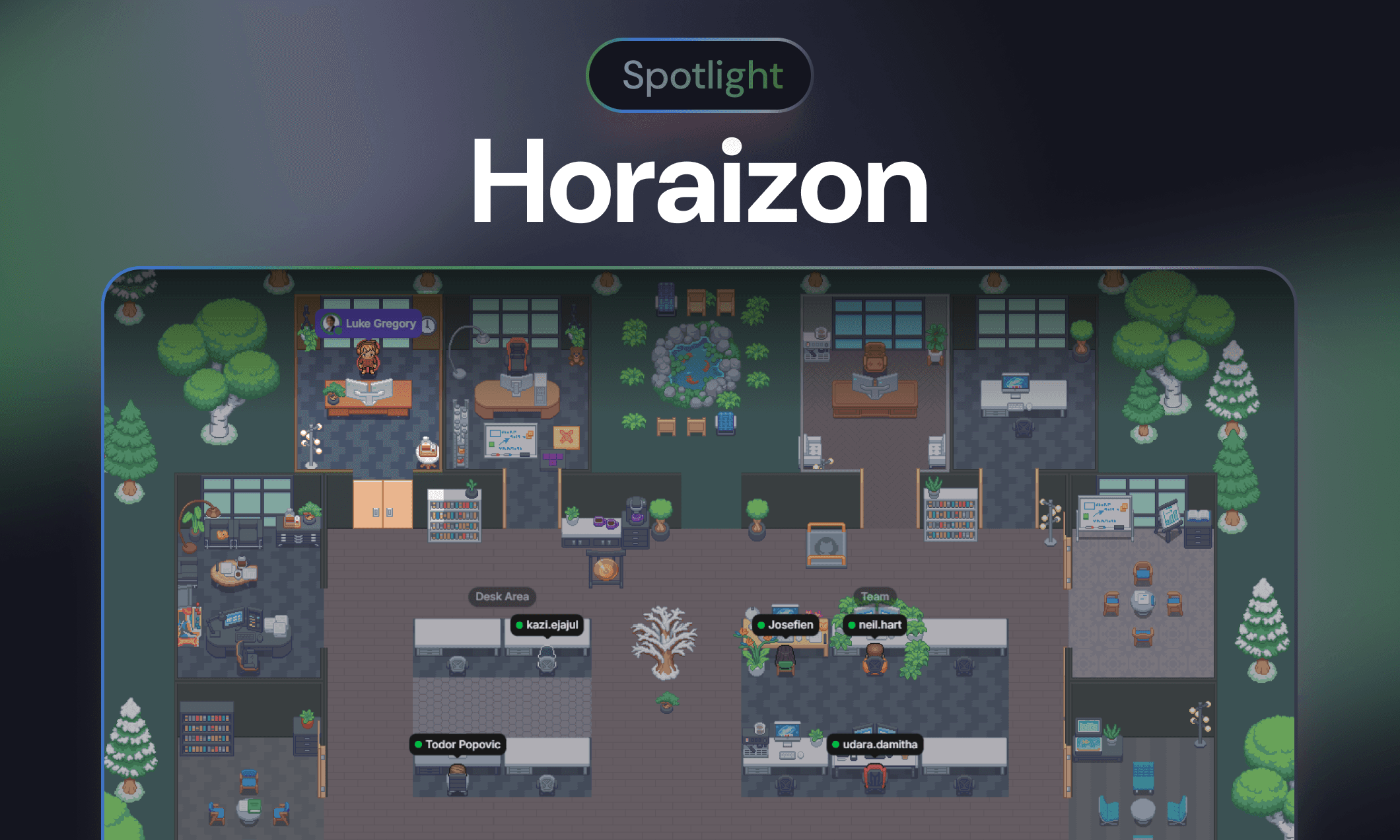
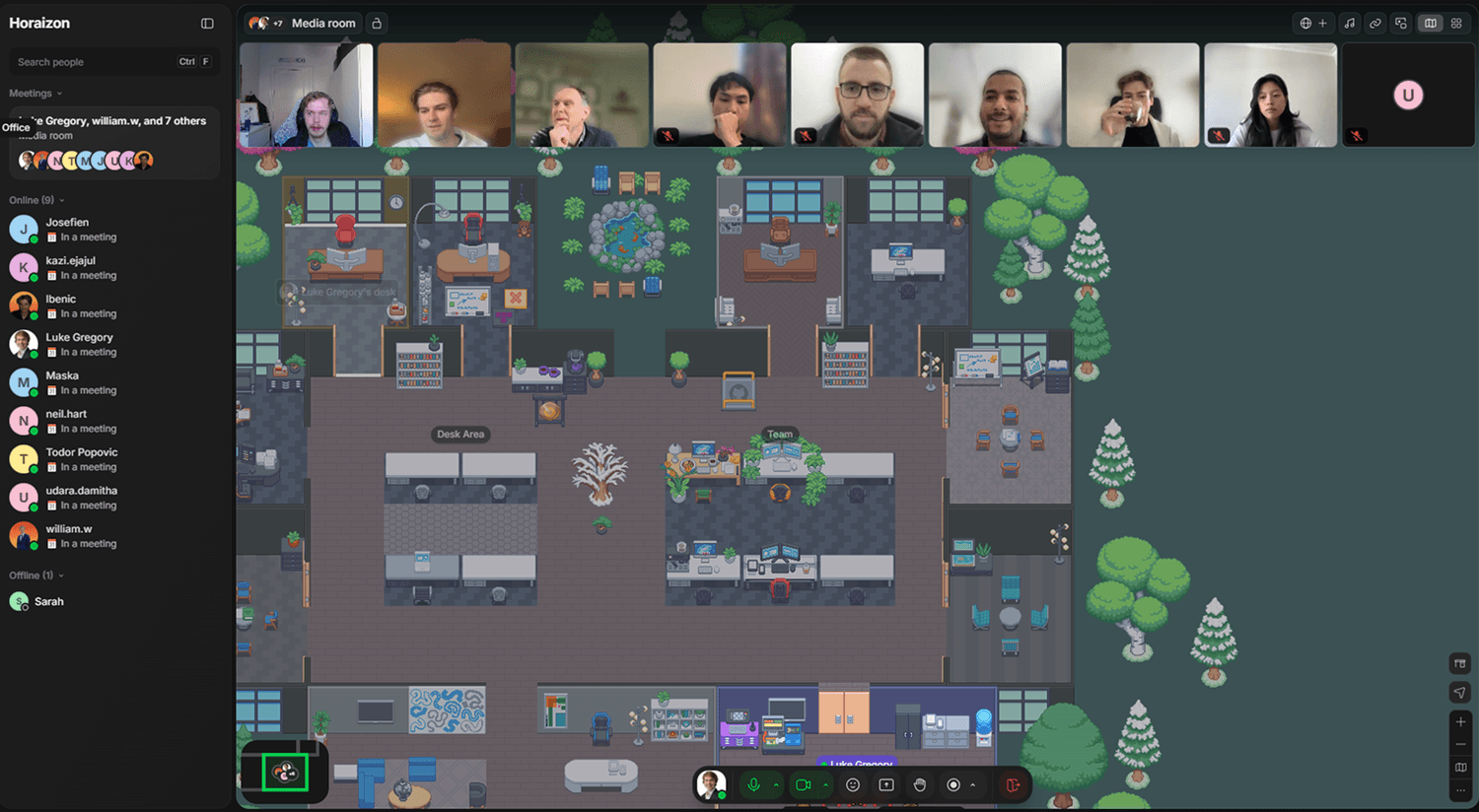
The Horaizon Gather office has a layout that suits them well: the three co-founders each have their own private office, and the developer team works in an open area in the middle. They’ve added extra desks as the team has grown, but mostly, their virtual office hasn’t changed much since day one.
The open developer area has been a quiet win. When Luke walks over to talk to a developer at their desk, the person sitting next to them can choose to naturally listen in (or mute to stay focused). “Sometimes you’re talking to someone, and the person next to them might be able to lend some helpful knowledge that you weren’t aware of before,” Luke shared.
There's a lot of skill overlap on the Horaizon team, and that ambient openness turns casual desk conversations into impromptu collaboration moments. It also just breaks up the monotony of the day by adding a little background conversation, the digital equivalent of a coffee break nearby.
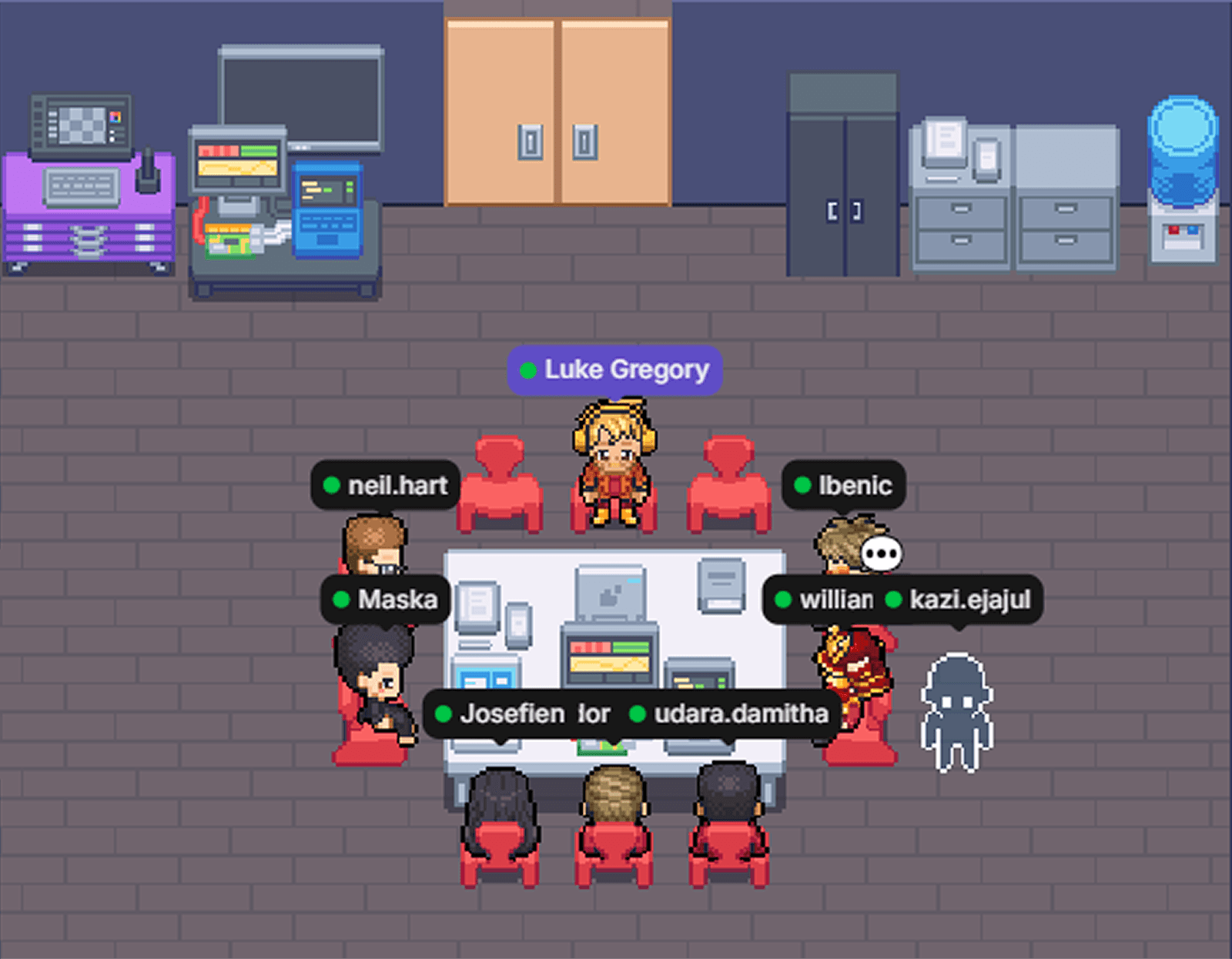
Every Monday morning, the team gathers in a meeting room to kick off the week. Luke gives a full company overview, lays out the week's priorities, and sets the tone. Tuesday through Thursday, they run a 20-minute daily standup where each developer covers what they did yesterday, what they're tackling today, and any blockers. Short, structured, and useful.
Fridays are different. The standup gives way to a knowledge share where one person shares an industry topic, a tool they’ve been exploring, or a personal passion project. The topic doesn’t really matter, as long as it sparks conversation and helps the team learn something new about each other.
The people-first philosophy behind Horaizon's remote culture
Luke thinks about remote culture more carefully than most. In the year between university and launching the company, he deliberately worked at an early-stage startup. Every week, he took notes about what was done well and what could be improved.
His core belief: remote culture doesn’t just happen naturally; you have to put in the effort to build it.
Part of that effort is understanding that your team isn't one monolith. There are some people who absolutely love working from home. Maybe they have a wonderful home office, space to focus, and get to socialize with their spouse. And then there are people who miss the face-to-face contact. Maybe they just graduated, moved to a new city, and don’t know many people yet. You can’t manage both of those people the same way.
For the person who needs more connection, Gather gives Luke a way to check in without it feeling like surveillance. "I’d feel weird calling them four times a day," he said. "They might think I'm checking up on them, making sure they're working." But walking over to their virtual desk to say, “Hey, I was just speaking to someone else and saw you’re active. I wanted to check in, how’s it going?” is a completely different energy.
Every quarter, Horaizon does a full review of processes and culture. Early on, Luke asked the team directly: keep Gather, or go back to how things were? Every time, the vote has been 100% in favor of keeping their virtual office.
That's not a number Luke takes lightly. He’s curated a team of thoughtful builders who push back on tools that aren't earning their place. Gather has earned its place.
"People are everything, really. If we can move the needle 10% in the right direction instead of 10% in the wrong direction, you've got a 20% increase in efficiency and output. And there are smiles on those faces. Smiling is infectious."
Luke Gregory, CEO, Horaizon
Remote Doesn't Have to Feel Remote
The problem Horaizon faced when they started hiring wasn't really about tools. It was about presence, the feeling that your team is actually there, that you're building something together, that the person at the next desk (virtual or otherwise) is reachable without a meeting invite.
Gather gave them that presence. And for a company that moves fast, cares deeply about its people, and is building something worth building together, that turned out to matter a lot.
If you're leading a distributed team and wondering whether remote culture is something you can actually build on purpose — it is. You just need the right place to do it.
And if you want to see what that looks like for your team, start your free 30-day trial and build your own virtual office.